
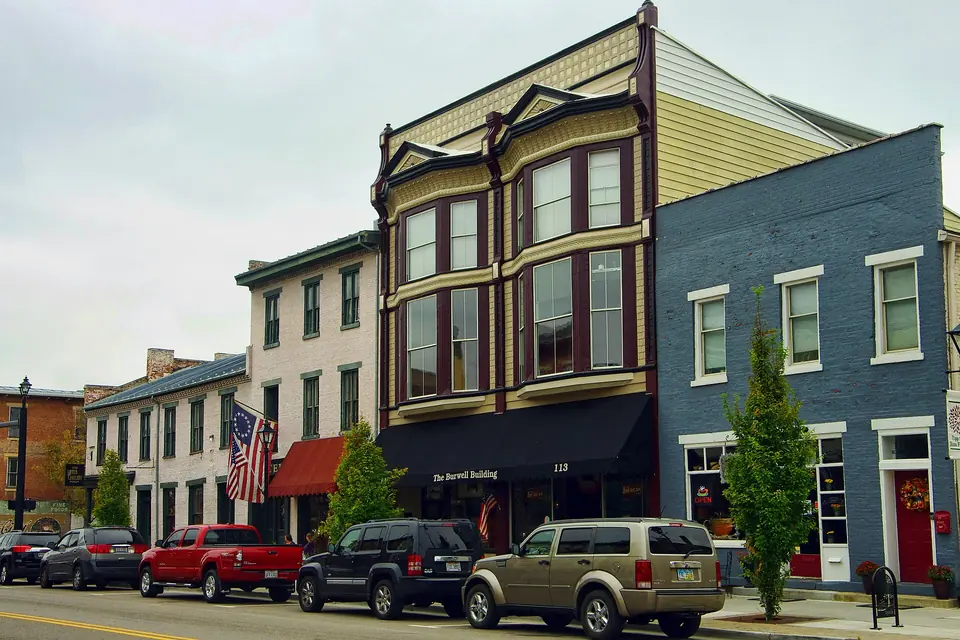
Planning a project in Tipp City
For a Tipp City maintenance request, note where water overflows or collects after rain. Photos taken safely from the ground can help explain gutter, downspout and exterior finish concerns.
Tipp City · Buildings & backstory
A canal crossing that became a lasting town center
Where road and canal met
John Clark platted Tippecanoe in 1840 where the Miami and Erie Canal met the Springfield-Greenville road. The original 17 lots gave a small settlement access to both waterborne trade and overland travel.[1]
Main Street grows with trade
The commercial district expanded along Main Street. The population reached nearly 950 in 1860 and more than 1,700 by 1900, as a town surrounded by farmland gained businesses and permanent buildings.[2]
A shorter name
The community became Tipp City in 1938 to distinguish it from another Ohio town. Its older streets and buildings carried on the history of Tippecanoe.[3]
Better access to distant markets
Clark understood the difficulty of reaching distant markets: he had hauled hides, flour and pork by flatboat. The canal-and-road junction offered farming families and merchants a more promising place to trade.[1]
John Clark’s plan for lasting buildings
Clark obtained the future town site from his brother-in-law Robert Evans in 1839. He encouraged substantial brick and frame construction rather than log buildings, leaving a visible influence on the town’s surviving architecture.[1][2]
Brick and wood in the old district
Brick walls and traditional wood siding remain central to the old restoration district. The city’s design guidance treats their preservation as part of maintaining the character of the whole street.[4]
Materials made to be maintained
Durable brick and repairable wood details help explain the district’s survival. A repair that matches the existing material and profile can maintain that continuity.[4]
Check before covering original surfaces
Brick still needs upkeep. Avoid automatically covering masonry with siding or paint; the district guidance discourages these changes. Check the applicable review process before planning exterior alterations.[4]
The care notes describe considerations for these building types, not an inspection of any property. Original materials, later alterations and condition determine the right repair.
Sources & further reading
- Tippecanoe Historical Society: the beginning
- Tipp City: historic preservation plan
- Monroe Township: Tippecanoe and Tipp City
- Tipp City: restoration district design guidance
Historical sources reviewed October 2026. Population figures refer to the year and area stated.
Where to begin
Gutter cleaning
Keep water moving in the right direction.
↗Exterior painting
Freshen the details that frame your home.
Your Tipp City project checklist
- Describe where rainwater overflows or pools and when you notice it.
- Take gutter and downspout photos safely from the ground.
- Mention guards, underground drainage connections or known leaks when discussing cleaning.
Local project questions
What should I send for a Tipp City quote?
Use the checklist above, your ZIP code and a short description of the outcome you want. John reviews the scope, materials, access and availability with you before a visit is agreed.
Is a visit automatically booked online?
No. Use the project form, call or text to request a quote. A visit is scheduled only after you discuss availability and agree on the scope.