
Planning a project in Miamisburg
For a Miamisburg interior update, consider the sequence from floor to trim to final paint. Send product selections before the visit so transitions, baseboards and door clearances can be reviewed.
Miamisburg · Buildings & backstory
River trade, mill work and the streets that followed
Lots beside the river
Miamisburg’s town lots went on sale in 1818 through Emmanuel Gebhart, Jacob Kercher, John Treon and Peter Treon. The first offering contained 90 lots near the river; Daniel Gebhart soon laid out another plat to the south.[1]
Families who shaped the town
The Treons were physicians as well as participants in the original land venture. Together with Gebhart and Kercher, they helped turn the earlier settlement into town lots. Later merchants and manufacturers added their own buildings rather than following one citywide housing plan.[1]
Trade follows the canal
Canal transport, mills and later rail connections expanded the local economy. The river and transport routes helped attract work well beyond farming.[2]
A community builds its institutions
Early residents raised money for a shared schoolhouse. A congregation formed in 1820 and used the school before a brick church was built in 1830—an example of gradual investment in permanent buildings.[3]
Work, trade and community life
Many early families came from eastern Pennsylvania and spoke a German dialect. Milling, carriage making and other trades grew beside agriculture, tying household life to the town’s commercial and industrial development.[1]
Markets, theaters and civic landmarks
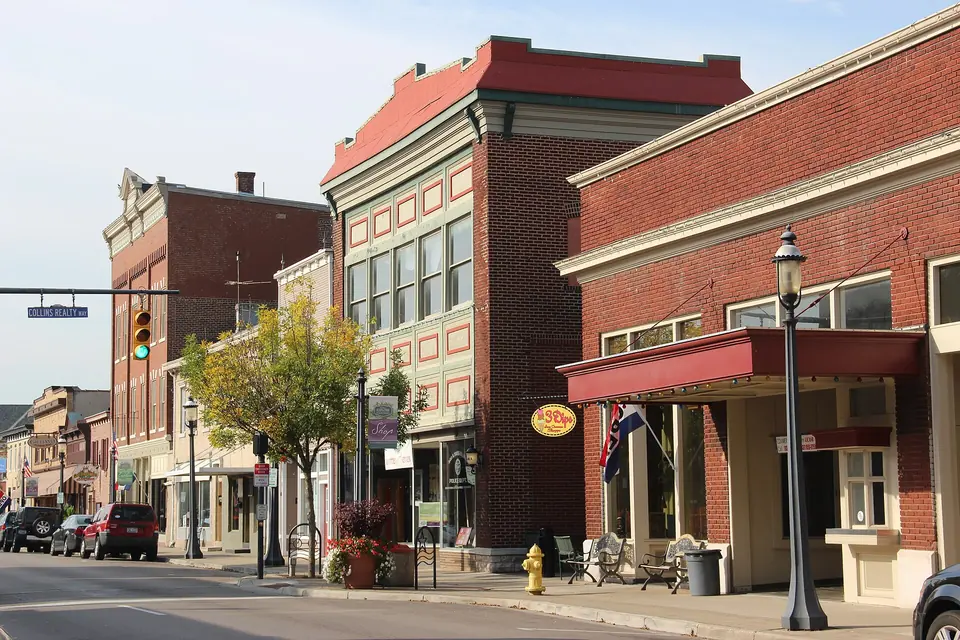
Market Square began in 1851 as an open-air market with civic rooms above. The brick Baum Opera House followed in 1884. The Masonic Temple adds another layer: a nineteenth-century church was later adapted with an Egyptian-inspired facade.[6]
Keep the street-front character
Traditional windows, porch details and substantial masonry can give an older property a recognizable character. Keeping sound pieces allows repairs to blend with the existing building.
Use a repair that suits the material
Moisture and unsuitable mortar can damage old brick. Before covering a wall or applying a new coating, identify the material and its condition; historic masonry repairs may require a specialist.[5]
The care notes describe considerations for these building types, not an inspection of any property. Original materials, later alterations and condition determine the right repair.
Sources & further reading
- Miamisburg Historical Society collection: Industrial Miamisburg
- Dayton Metro Library: historical review of Miamisburg
- Trinity Church: early school and church buildings
- Miamisburg Historical Society: neighborhood history
- National Park Service: caring for brick masonry
- Miamisburg Historical Society: historic buildings
Historical sources reviewed October 2026. Population figures refer to the year and area stated.
Where to begin
Flooring installation and repair
A practical foundation for daily life.
↗Trim and finish carpentry
Small details. A more finished home.
Your Miamisburg project checklist
- Share the flooring selection and photos of thresholds between rooms.
- Discuss which baseboards can stay and which need removal or replacement.
- Confirm the order of floor work, trim fitting and final paint touch-ups.
Local project questions
What should I send for a Miamisburg quote?
Use the checklist above, your ZIP code and a short description of the outcome you want. John reviews the scope, materials, access and availability with you before a visit is agreed.
Is a visit automatically booked online?
No. Use the project form, call or text to request a quote. A visit is scheduled only after you discuss availability and agree on the scope.